

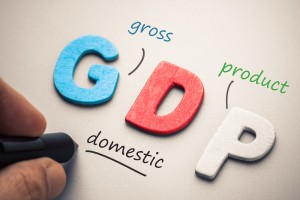
 Canada’s early 2017 GDP numbers measure nothing.
Gross domestic product doesn’t measure the long-term viability of a financial system built on artificially low interest rates. Nor does it measure the quality of goods, and certainly, not the depth and meaning we assign to each marginal unit. For, even a broken window contributes to the GDP.
But that didn’t stop Avery Shenfeld, chief economist with CIBC World Markets Inc, from saying, “The fireworks just went off for Canada.”
“We have liftoff,” echoed Douglas Porter, chief economist with BMO Financial Group.
But despite growing by 0.6 per cent, Canada’s gross domestic product did not assess the actual value of goods and services in January 2017. Whatever data economists are pulling from manufacturing, resources, wholesales goods and retail is overshadowed by a logical structure they’re forgoing.
GDP is like a measurement that tracks irregular and subjective ticks. Like celebrating the anniversary of someone you don’t know.
“Although it is still early days and risks abound, signs are pointing to an economy that looks increasingly poised to shake off the setbacks of recent years,” said Brian DePratto, senior economist with TD.
Meanwhile, even a broken window is contributing to the GDP.
GDP measurements avoid “double counting,” by ignoring many capital goods, while understating the contribution of trade by subtracting imports from exports. Government spending is also assumed to be productive and deserving.
Throughout its existence the Soviet GDP was comparable with the US. A mere year before its collapse, the Soviet GDP was half of the US’s.
What was being measured? Apparently, not the goods and services people actually valued.
The GDP measures broken windows. The Soviet economy was a giant broken window experiment. The GDP should have had “lift-off” and gone to the moon.
But barely edible breads are not valuable. There ain’t no accounting for opportunity costs the way economists imagine.
Canada’s economy is not a machine that absorbs inputs and distributes outputs. GDP is not an objective measurement reporting on how well the machine is performing.
GDP is a poor reflection of reality. Statistics Canada cannot report “economic growth” anymore than the Soviet planners could.
Oh wait, Avery Shenfeld from CIBC has some insight: “Even for those of us with enough experience to downplay any one data point, the fact that GDP is up 2.3 per cent from a year ago, and is gaining leadership from the ‘right’ sectors, makes a compelling case that we’ve put the post-oil-dive blues behind us.”
Good point, but the oil-dive blues is part of the cure, not the disease. Thanks to central bank meddling — easy money, speculation, and leveraging are still at all-time highs.
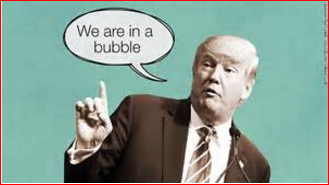
Canada’s real estate bubble has very real consequences for the broader economy. Even a 0.6 per cent result for January 2017 doesn’t negate the fact that, currently, in Canada, prosperity is borrowed, not earned.
GDP is an idea only Keynesian economists could take seriously, and Keynesian economics is a joke. It is soft Marxism.
Even a broken window contributes to the GDP. And eventually, like the communists, we’ll have nothing left but broken windows, regardless of whatever the GDP reads.





Facebook
YouTube
RSS