A recent CBC report exposes that Newfoundlanders and Labradorians often pay at least twice as much for dairy than Ontarians. Indeed, milk consumers in Windsor can often expect to pay around 91 cents per litre, while it’s been reported in some remote NL communities to be upwards of around 3 dollars per litre. In fact, on average, Canadians pay almost 43% more for our milk than our American counterparts - so even those on the mainland are getting gouged.
What’s going on? Even for the lactose intolerant among us, this is a raw deal.
Since the 1970s, Canada has run a system of “supply management“, where industry supply is directly controlled by dairy farmers’ boards and enforced by the government. In essence, this means that quotas are set for both production and market entry, requiring farmers to purchase rights-to-produce. These boards also set prices, while the government sets tiny import quotas and high tariffs to protect from foreign competition.
This is aimed at promoting protecting both consumers and producers from wild market fluctuations that come with globalized trade. It also is to promote local Canadian agriculture and ensure product quality.
What does it actually do? As has been shown, Canadian consumers across the board pay more for dairy products. In fact, it’s estimated by the Conference Board of Canada that Canadian families can expect to spend around $276 more per family on dairy alone than our counterparts in the developed world. Dairy Farmers of Canada claims that Canada, unlike our partners, does not devote subsidies to agriculture, implying that somehow consumers are not forced to give domestic producers ‘special treatment’. A cursory glance at the reality, of course, is that consumers are indeed paying a subsidy through the inflated prices. What’s more, the WTO places limits on exports for subsidized goods. While DFC claims supply management isn’t “subsidization”, the rest of the world seems to disagree. As supply is limited, prices go up. As market entry is limited, and trade almost nonexistent, competition is reduced. This gives Canadian farmers an advantage that is essentially identical to that of a subsidy - only through increasing market power by these means - and they benefit just as much. Indeed, Canadian dairy farmers are by far some of the best paid in the world.
The “unintended” consequences extend beyond this. Canadian jobs, paradoxically, are being lost as Canadian companies, seeking to expand, invest overseas. Even if regulatory bodies were to raise the quotas and slash rules to allow for more rapid domestic expansion by giants like Saputo, no bureaucrat is sharp enough to keep pace with market forces. Thus, economic benefits are pushed beyond our borders. The WTO’s restrictions on exports make further investment in Canada even less appealing.
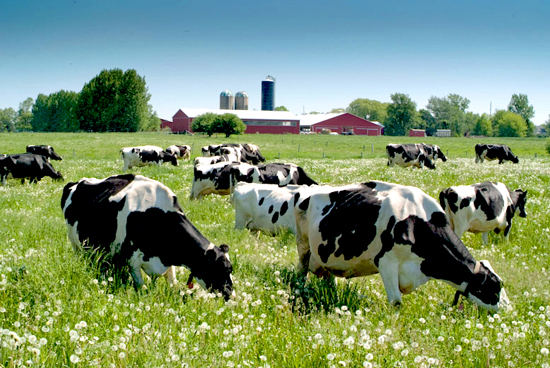
Quotas and regulation make market entry incredibly difficult, concentrating market power in the largest firms. One must actually purchase quota rights to even begin producing. This is exacerbated in Newfoundland, which, arguably more than most provinces, pushes aggressively for local produce. Not only is the NL market very small - arguably too small to justify domestic production on this scale - but Newfoundland’s remoteness and lack of availability of many inputs further drive up costs. The provincial government recognizes this, and instituted an initiative to allot land for homegrown feed (the chief expense of NL dairy farmers). Unfortunately, this just drives the province further down what is ultimately an inefficient rabbit hole. All of this has consequences for the market structure: Newfoundland has the most concentrated dairy industry in Canada, with just 34 farms, yet with over 174 cows per farm. Even PEI, with 200 smaller farms, produces more than twice the milk of NL.
None of these consequences seem good. So what benefits to Canadians (other than the dairy industry) come with supply management? Honestly, it’s hard to tell. “Quality” is ensured by supposedly stringent regulations, but this is a rather nebulous concept, and can often be subjective. It does indeed protect the market from wild price fluctuations, but many other Canadian agricultural markets are unregulated and do not see insane volatility - it seems the forgone benefits in purchasing power and jobs far outweigh complications that come with price volatility. Disappointingly enough, it seems that the only solid answer dairy farmers like Pondview Farms’ Crosbie Williams can give is “Everybody knows that locally grown, locally produced is better…”
The benefits vs. costs of the local-produce movement are complex and numerous, but, in short, this is a highly dubious and highly subjective claim. Many consumers may think that cheaper, imported milk from Nova Scotia for PEI is “better”.
It ought not be up to producers to decide consumers’ preferences for them. Supply management is a net loss for Canada, and certainly a grave loss for Newfoundland.
Tags: Canada, conference board, dairy, dairy farmers, milk, supply management