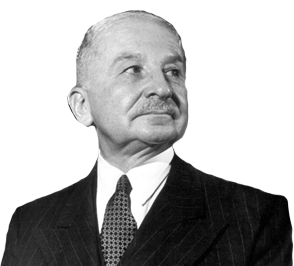
Ludwig von Mises wrote that, “[d]emocratic control is budgetary control. The government has but one source of revenue—taxes. … But if the government has other sources of income it can free itself from this control.”[1] This principle is particularly important for understanding the internal politics of Canadian Native tribes, whose governments are the recipients of large transfers from the Canadian federal government.
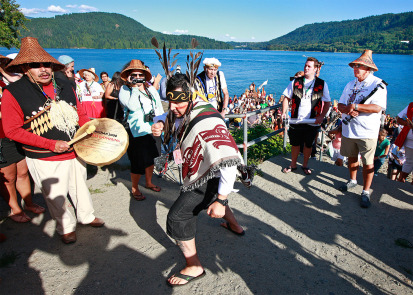
A recent scandal involving the Squamish Nation, a Vancouver-area tribe with a population of about 4,000, is a case in point. Two political officials of the band spent $1.5 million from an emergency fund for their personal ends. According to the investigation that eventually exposed them, “it was clear they handed out funds to develop political support from members.” [2] The scandal derives from the fact that funds earmarked for one purpose, emergencies, were used for a different purpose. But the interesting economic story would nonetheless hold if the funds had been used only for their intended purposes.
According to its most recent financial statements,[3] the Squamish Nation earned $11.3 million from Aboriginal Affairs and Northern Development Canada, i.e. the Canadian Federal Government, and only $8.4 million from taxation in 2014. As Mises suggests in the quote above, a government with alternative sources of income besides taxation can use this income to free itself from democratic control. Robbing Peter to pay Paul is a favourite activity of all governments, but when the robbery occurs through taxation, it is at least limited by Paul’s awareness that he is being robbed.
Native governments are enriched by transfers. However, we cannot conclude that Native people are likewise enriched; that would require us to understand the incentives those transfers create. One clear impact of a wealthier government is that it pays to control that government. The officials who appropriated the emergency fund could conceivably have spent that money on many things; they chose to spend it building political support. This tells us that the officials considered political support to be more valuable than anything else they could have bought. From their perspective, control of the emergency fund was the profit from their previous political activities. Like market entrepreneurs, they ploughed their gains back into their business: politics. This continued, apparently, for years before the scandal emerged: one official had been in office since 1997, the other for over twenty years.[4]
Another clear impact of a wealthier government is that it pays to be connected with government officials. It certainly paid to be connected with these two corrupt Squamish officials, who lavished restaurant meals and tickets to sporting events on others to garner support, but it would also pay to cozy up to less corrupt officials. Suppose, for instance, that the emergency funds were being administered by incorruptible bureaucrats who would use them only for emergencies. There would still be some discretion in their distribution: If a flood affected everyone, the well-connected could get payments sooner. If payments were distributed according to appraised damages, the appraisals could be more generous for some than for others. Even if bureaucrats themselves have no intention of being corrupt, bureaucracy always advantages those who know who to talk to and which forms to fill out.
Thus, when the government is wealthier, it is worthwhile to divert one’s efforts and resources away from productive activities and towards becoming better connected with the state apparatus. Gaining wealth through politics is a negative-sum game: If one person manages to position himself to get a larger share of government largesse, some other person must get less. The net loss comes from the efforts expended in attaining politically favourable positions. This is emphatically not the case in the market, where productive activities enrich people by creating wealth that would not otherwise exist.
Any gains to Native people from the funds transferred to their governments and distributed among them by various means are offset by the perverse incentives the distribution process creates. This fact must contribute to the generally poor economic state of many Native tribes. There is no intrinsic reason why Native tribes should be poorer than other Canadian communities. In fact, to the extent that they are exempt from many Canadian laws and regulations that hamper the free operation of the market, Native tribes have a potential advantage over the rest of Canada. If the members of a given tribe were to adopt an ideology friendly to the free market, they could turn their territory into a Hong Kong: a small area deriving economic benefits from having a freer economy than the larger region around it.
Unfortunately, living under government largesse tends not to promote free-market attitudes. This is a secondary effect of the perverse incentives to strive for political power and influence. In striving for these things, people tend to promote and affirm the ideology that justifies them. This observation must not be taken as deterministic, however, as there are no concrete laws governing how people form their beliefs and values.
There is great opportunity in living in a small and relatively autonomous political unit such as a Native tribe. In general, smaller political units’ governments can be monitored and controlled by the public to a greater extent than those of larger political units. Whether this control translates into greater prosperity depends on whether the public holds a set of values consistent with freedom and prosperity.
[1] Mises, L. (1944). Omnipotent Government. p. 252. URL: http://mises.org/etexts/mises/og.asp
[2] Squamish Nation officials lose authority over finances after investigation. CBC News. October 20, 2014. URL: http://www.cbc.ca/news/canada/british-columbia/squamish-nation-officials-lose-authority-over-finances-after-investigation-1.2805719
[3] Consolidated Financial Statements of Squamish Nation. March 31, 2014. URL: http://www.squamish.net/wp/wp-content/uploads/2014/08/Squamish-Nation-AR-March-2014.pdf
[4] Squamish Nation members demand financial report after manager removed. CBC News. October 1, 2014. URL: http://www.cbc.ca/news/canada/british-columbia/squamish-nation-members-demand-financial-report-after-manager-removed-1.2783168
Tags: aboriginal issues, First Nations, indigenous peoples, squamish nation