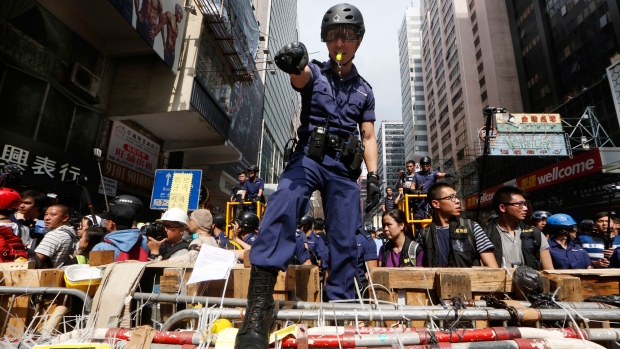
One of the most heated topics last month was the protest in Hong Kong, led by students who were later joined by other Hong Kong citizens. The main issue between the government and the protesters is the Chief Executive Election method for 2017. The Basic Law states that “the ultimate aim is the selection of the Chief Executive by universal suffrage upon nomination by a broadly representative nominating committee in accordance with democratic procedures.” As of right now the Chief Executive was nominated by a committee of 1200 people, which is not via universal suffrage. Protesters are concerned that democracy and freedom in Hong Kong will be lost, and that their interests will not be represented.
This protest, otherwise known as the “umbrella revolution” by some media outlets, lead people to focus on the possible outcomes of these events, namely, to vote or not? However, voting (or democracy) is only one part of liberty, and the focus on change should include reforms of all institutions. The improvements of all these institutions will take time and great effort.
According to the 2014 Index of Economic Freedom, Hong Kong ranked no.1 with an overall score of 90.1 (The Heritage Foundation, 2014). This index consists of four major parts: the Rule of Law, Limited Government, Regulatory Efficiency, and Open Markets. According to the Heritage Foundation, Hong Kong scored its highest ever score this year. The lowest scores are Monetary freedom, under regulatory efficiency, which is 82; and Freedom from Corruption, under “Rule of Law”, which is 82.3.
Hayek (1943) develops the idea of the “Rule of Law” in his book, The Road to Serfdom. He sees the drawbacks of democracy, and argues that a free society can only exist if the government is bounded by the Rule of Law. The Rule of Law “means that government in all its actions is bound by rules fixed and announced beforehand”. So the Rule of Law is fixed and general, and everyone knows what to expect when certain actions take place. This also implies that the responsibility of the government is to act to ensure the Rule of Law, rather than to advocate policies based on popular preference.
Hong Kong is a business hub, so elites in the business sector can have a significant amount influence on policy directions. Crony capitalism may arise as a result. The protesters’ concern that the 1,200 people will only represent the stakeholders’ interests is reasonable. However, democracy cannot prevent crony capitalism, especially in a business oriented region like Hong Kong. People who have studied social choice theory (Arrow 1963) understand that individual rational choices can lead to irrational outcomes, so one cannot necessarily count on his vote to make a positive change. Social choice theory suggests that if there are equal to or more than three candidates and voters, rational individual choices cannot be reflected in the overall outcome. For instance, three candidates, 1, 2, and 3 go to election, and A, B, C are the three people to vote for them. A’s preference is 1>2>3, and B’s is 2>3>1, C’s is 3>1>2. By the majority rule, 1 beats 2, 2 beats 3, but 3 also beats 1. This is a paradox.
The major focus should be on the Rule of Law. The question to ask is how to make sure the government is bounded by the law, and how the Judiciary and Legislative Council will be well maintained. Hong Kong inherits British Common Law, which is more complete than the civil law in mainland China. It will be easier to make changes. These institutions are the keys to a free society, and they need much more time and effort to be improved. Changes may be minor, and less noticeable than a request to vote for a Chief Executive, but these institutions will be far more reliable.
References
Arrow, K.J.(1963) Social Choice and Individual Values, New Haven: Yale University
Press.
Hayek, F.A (1943, re-printed 2007) The Road to Serfdom, Chicago: University of
Chicago Press.
The Heritage Foundation (2014) 2014 Index of Economic Freedom.
Tags: hong kong, Limited Government, open markets, Regulatory Efficiency, rule of law